Cheapest AI Search API? A Benchmark of Exa, Tavily, Perplexity, and Linkup

The Linkup Team
As agentic AI workloads scale, search API costs can grow rapidly and unpredictably. We benchmarked four providers under identical conditions to understand how they compare in real-world usage.
Abstract
We conducted a controlled cost comparison across four leading AI search providers: Exa, Tavily, Perplexity Sonar, and Linkup. Each provider was evaluated under identical conditions: +200 benchmark queries, 10 sources requested per call, and standard configurations. We report the cost per 1,000 queries, standard vs. deep search tiers, and the total cost to process the full query set for each provider.
Under these conditions, Linkup emerges as the most cost-efficient and predictable provider overall, with the lowest cost for 1,000 queries at both standard and deep search tiers. We describe our methodology, limitations, and practical implications below.
Study Motivation
A recurring issue in developer communities is managing API costs as systems move from prototype to production. Early usage is often covered by free tiers, but costs increase sharply once workloads scale.
Agentic systems amplify this effect. A single user interaction may trigger multiple tasks and search calls, making total spend dependent on both system design and pricing models.
Each API uses a different pricing model : ranging from flat per-query and credit-based models to token-based and hybrid approaches. While performance benchmarks are common, controlled comparisons of cost under equivalent conditions are less explored. This study aims to determine an actual cost per call.
Setup and Parameters
To test all systems under identical conditions, we:
- Built a 200 query benchmark drawn from real-world enterprise use cases: business intelligence, regulatory research, competitive analysis, and multi-entity lookups. Queries were selected to reflect varying complexity levels, from simple factual to multi-hop queries.
- Prompted all four providers with identical queries and no special configurations or tuning.
- Configured all providers to return 10 sources per query. Multi-source retrieval decreases hallucination risk, improves coverage, and reflects how search APIs are actually used in enterprise research, compliance, and business intelligence contexts.
- Prompted all AI search providers using identical prompts and the standard/default API tier access.
Note: Linkup often returns up to 20 sources by default for deep queries. For fairness, we constrained all providers to 10 sources.
Results
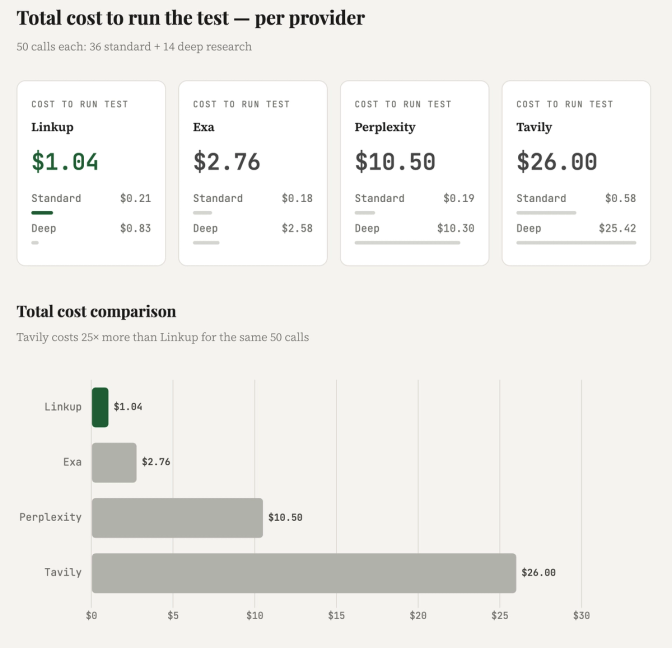
While standard-tier pricing appears relatively comparable across providers, material differences emerge once workloads scale and deeper research modes are invoked.
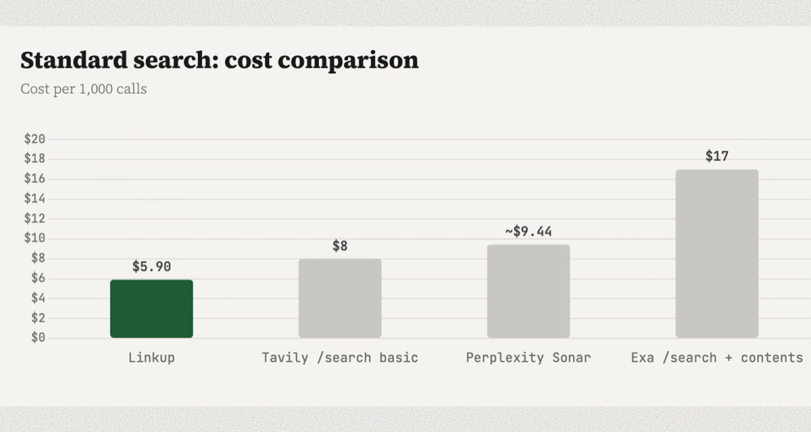
At the standard tier, pricing remains relatively close in nominal terms. However, even at this level, Linkup is approximately 64% cheaper than Tavily. Exa and Perplexity cluster in a similar range to Linkup.
Deep search is the inflection point. This is where pricing models diverge most in both magnitude and predictability. This is most relevant to agentic systems where queries require multi-step reasoning and broader retrieval. In this setting, pricing models – not just pricing levels – become the dominant factor.
Linkup Deep at $59/1K is the only predictable deep research price in this evaluation. Other providers exhibit one of the following:
- Unbounded variability, driven by token-based pricing (Perplexity)
- Implicit cost scaling, driven by credits or per-result expansion (Tavily, Exa)
- Credit-based models (Tavily) have bounded cost per calls, but credit consumption varies by query type and depth setting, requiring careful profiling before production deployment.
Flat per-query pricing allows teams to calculate infrastructure costs with high confidence before deploying. This predictability affects budgeting, rate-limit planning, and investor reporting.
Methodology
We measure cost under controlled, identical conditions to isolate the impact of pricing model design from query variability.
- Execute the full 200-query benchmark under both standard and deep configurations
- Record total cost accumulated by each system
- Compute the average cost per query and normalize results to cost per 1,000 queries (CPM).
This approach avoids reliance on theoretical pricing estimates sand instead reflects realized cost under workload.
Pricing Model Summary
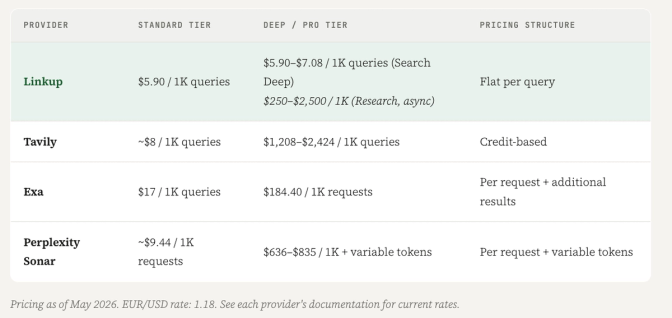
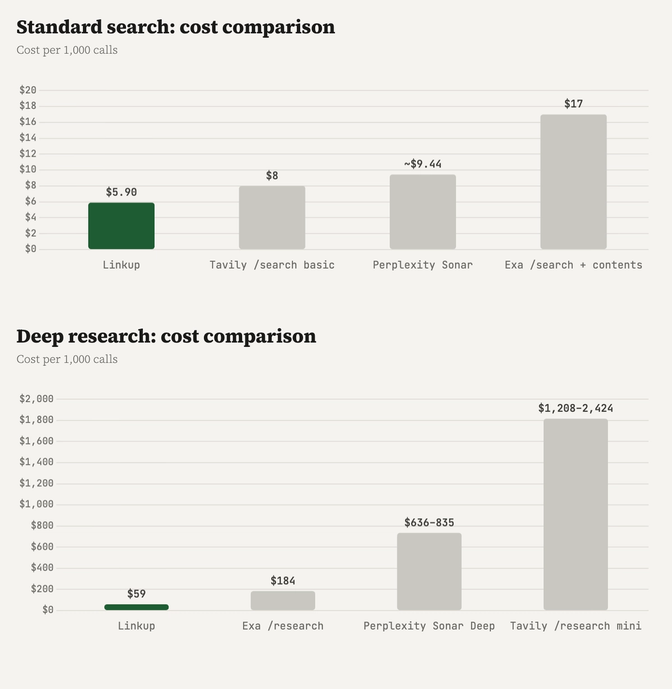
At the deep research tier, where queries require multi-step reasoning and broader source coverage, the gap between providers widens significantly. This is not only a function of higher nominal prices, but of how pricing scales with query complexity.
Limitations
Several constraints should be considered when interpreting these results.
Pricing is dynamic. API pricing can change frequently. Any specific figures in this post should be verified against current provider documentation before production planning.
Token costs are estimated. For instance, Perplexity’s total cost depends on output length, which varies significantly across queries. Our estimates are based on observed distributions within the benchmark, but production workloads may differ.
This benchmark focuses exclusively on cost. It does not evaluate retrieval quality, latency, or source reliability under these configurations. For a performance-oriented analysis, read and try our evaluation of AI search systems on complex queries.
Basic configurations. Enterprise pricing tiers, volume discounts, and custom agreements were not modeled.
Self-evaluation. This benchmark was conducted by Linkup. We publish methodology details to enable independent replication.
Practical Implications
For teams deploying AI search in production, the primary takeaway is not simply which provider is cheapest – it is which pricing model remains stable under scale.
The predictability problem.
Flat per-query pricing (used by Linkup) enables teams to model cost before deployment. Given a known query volume, total infrastructure spend can be calculated deterministically. This has direct implications for financial planning, rate-limit and capacity design, and external reporting.
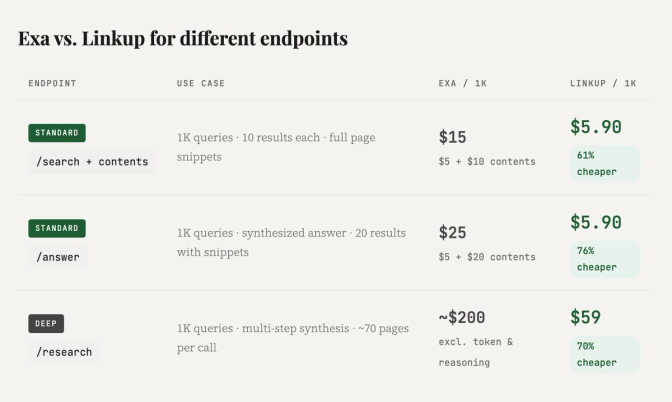
The table illustrates how cost predictability differs between Linkup and Exa as a result of pricing model design. At standard search, Exa’s /search + contents (~$15/1K) and /answer (~$25/1K) scale with added content and synthesis. The gap widens significantly in deep research: Exa’s /research reaches ~$400/1K, whereas Linkup Deep is fixed at $59/1K. This reflects a fundamental difference in pricing models – Exa scales with content volume and reasoning depth, while Linkup remains invariant, leading to materially different cost predictability.
Completeness and Performance.
In production systems, effective cost per query is shaped by system behavior, not just pricing. This includes:
- Retry rates. Providers that return unstable or inconsistent results increase the number of calls required per successful outcome.
- Follow-up queries. When responses are incomplete, additional searches are needed to fill gaps. In our blind, LLM-as-a-judge performance benchmark, Linkup exhibited up to 4× lower missing-entity rates than competing providers, reducing the need for iterative querying.
- Source diversity. Higher domain diversity per call reduces the probability of re-querying for alternative perspectives.
Conclusion
For teams operating at scale, predictability and consistency often outweigh marginal differences in nominal stated prices. Across this benchmark, Linkup is the cheapest AI search provider under identical conditions, at both standard and deep search tiers.
At the standard tier, Linkup and Exa are the most cost-competitive options. At the deep tier, differences become structural: Linkup provides the only fully predictable cost model, while competing systems introduce variability through tokens, credits, or result expansion.
To evaluate Linkup on your own queries? Get started for free – no credit card required.
To evaluate performance alongside cost, our full benchmark methodology and code are available here.
FAQ
What is the cheapest AI search API?
Based on this benchmark, Linkup is the cheapest AI search API across both standard and deep search tiers under identical conditions. It offers $5.90 per 1,000 queries at the standard tier and $59 per 1,000 queries for deep research, with no hidden token or credit costs.
Which AI search provider has the most predictable pricing?
Linkup provides the most predictable pricing model, using flat per-query pricing.
Other providers (Perplexity, Tavily, Exa) introduce variability through token usage, credits, or result expansion, making total cost harder to estimate in production – shown by accumulated costs to run the benchmark query set.
What is “deep search” and why is it more expensive?
Deep search refers to queries requiring:
- Multi-step reasoning
- More sources
- Broader retrieval depth
This increases cost for providers using token or credit-based pricing. Linkup is unique in offering fixed pricing for deep search, making costs predictable even for complex queries.
How should I choose an AI search provider?
Key factors to evaluate:
- Cost per 1,000 queries
- Pricing predictability
- Performance (accuracy, completeness)
- Retry and re-query rates
Read more about our performance benchmark here.
Sample Queries
The following queries are representative of the 200-query dataset used in this benchmark:
Standard search
- What is the current spot price of gold per troy ounce in USD?
- What are the top 3 AI startup funding rounds announced in the last 7 days?
- Who are the top 5 companies providing RAG infrastructure APIs in 2025, and what are their key differentiators?
- What is the current headcount, latest funding round amount, and headquarters location of Mistral AI?
- What was Nvidia's revenue and net income in their most recently reported quarter?
Deep research
- Summarize the most effective techniques for reducing hallucinations in large language models, citing the most important papers published since 2024.
- What are the main obligations for AI system providers under the EU AI Act that came into force in 2024-2025, and which compliance deadlines apply in 2026?