What is Retrieval-Augmented Generation and is it still relevant in 2026?

The Linkup Team
Retrieval-augmented generation is the dominant architecture for AI systems that need current, accurate, and auditable answers.
This post explains what RAG is, how the three components fit together, and what separates a retrieval layer that works from one that produces confident wrong answers.
What retrieval-augmented generation is
Retrieval-augmented generation is an AI architecture that combines a retrieval system with a large language model. Rather than relying solely on knowledge encoded in its weights during training, the model is given external documents at inference time and generates its answer from those documents. The architecture was formalized in a 2020 paper from Facebook AI Research and has been the dominant pattern for enterprise search generative AI pipelines since.
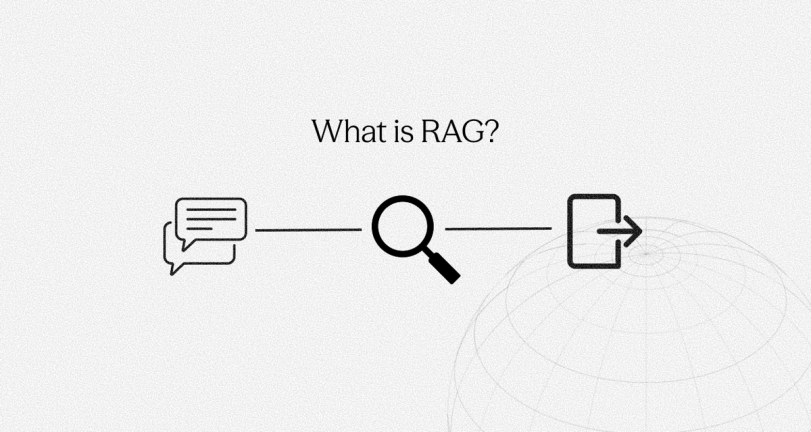
A RAG system has three distinct components that each do a specific job:
- The retrieval layer. When a user submits a query, the system searches an index, the web, or a private document store, and returns the most relevant documents. This can use keyword search, vector similarity search, or a hybrid of the two.
- The context injection step. Retrieved documents are formatted and inserted into the language model's prompt. The model reads them as context, not as training data.
- The generation layer. The LLM reads the query and the retrieved context together and produces a grounded response, citing or synthesizing from the documents rather than from parametric memory.
The practical effect is that a RAG system can answer questions about events that happened after the model's training cutoff, about documents the model has never seen, and about proprietary internal data, none of which a base model can do reliably.
Where RAG fails: the retrieval layer
Most RAG failures trace back to the retrieval layer, not the model. A frontier model given accurate, current, and relevant documents will generate an accurate answer. The same model given stale, imprecise, or low-quality documents will generate a confident wrong answer. This is why the web search API used in a RAG pipeline sets the quality ceiling for the entire system.
What a production retrieval layer requires in 2026
Four requirements separate experimental RAG setups from systems that meet the standard enterprise AI search demands.
- Freshness. Agents querying regulatory updates, market conditions, or competitive intelligence need results indexed within hours. Stale retrieval in legal or financial AI produces answers that are wrong at the moment they are generated.
- Source accuracy. A legal AI search engine needs caselaw weighted above SEO content. A financial research tool needs primary filings above commentary. A retrieval layer that cannot tune source weighting by domain underperforms on professional queries.
- Security. Queries sent to a third-party retrieval API are a data leak surface. Regulated industries require Zero Data Retention guarantees; the strictest deployments require retrieval infrastructure inside the customer's own cloud boundary.
Linkup's /search API scores 92% on Verified SimpleQA, ranking first among sub-second web search APIs. Benchmarked against Exa, Tavily, and Perplexity on 600 queries drawn from real user traffic, Linkup showed 2-3x higher source diversity and up to 4x lower missing-entity rates. For teams with the highest data sovereignty requirements, Linkup offers zero data retention and offers private cloud to cloud connectivity – so that queries are never exposed on the public web.
RAG in 2026
As AI models become increasingly open and interchangeable, the competitive advantage shifts toward retrieval: the ability to access the right information, in real time, with high precision and trustworthiness. The next generation of AI applications will not be defined solely by model capability, but by the quality of the infrastructure connecting models to knowledge.
Teams building enterprise AI search should treat retrieval quality as a first-class engineering decision. Learn more about Linkup here or learn more from our team here.
Frequently asked questions
What is retrieval-augmented generation?
RAG is an AI architecture that fetches relevant documents from an index at inference time and passes them to a language model as context, enabling grounded, current, and auditable answers without retraining the model.
Is RAG still relevant in 2026?
Yes. RAG remains the primary architecture for enterprise AI search because it solves grounding, currency, and domain customization problems that larger context windows and longer pretraining do not eliminate.
Why do most RAG failures happen in the retrieval layer?
The model synthesizes what it receives. Stale, imprecise, or low-quality retrieved documents produce confident but incorrect answers regardless of model quality. Retrieval quality sets the ceiling for the entire system.
What is a web search API for LLMs?
A web search API for LLMs is a retrieval service that returns structured, ranked web content formatted for use in a language model prompt, handling crawling, indexing, freshness, and source quality so the model receives clean context rather than raw HTML.
What does Zero Data Retention mean in a RAG pipeline?
Zero Data Retention means the retrieval provider does not store or log query content after returning results. For regulated industries, this is a compliance requirement and a standard condition of enterprise procurement in legal, financial, and healthcare AI.
How does an intelligent search engine differ from a standard web search?
An intelligent search engine built for LLMs returns structured, source-ranked content optimized for model consumption. Standard web search is optimized for human click-through. The retrieval architecture, output format, freshness cadence, and source weighting are different by design.